|
Romans 8:1-2 says,
“There is therefore now no condemnation for
those who are in Christ Jesus. For the law
of the Spirit of life has set you free in
Christ Jesus from the law of sin and death.”
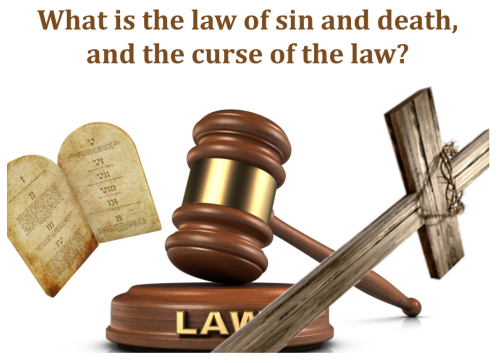
What is the law of sin and
death?
To understand what Paul meant by “the
law of sin and death” we have to
look at what he said earlier in the book of
Romans. Sin was in the world before the law
was given. Romans 5:13-14 says, “for sin
indeed was in the world before the law was
given, but sin is not counted where there is
no law. Yet death reigned from Adam to
Moses, even over those whose sinning was not
like the transgression of Adam, who was a
type of the one who was to come.”
Sin
was not imputed until the Law of Moses was
given. Imputed means “to charge to one’s
account,” as by an entry made in a ledger.
In other words, sin was present in the world
from Adam to Moses, but God did not keep an
account of sins before the giving of the Law
because there was no Law to obey or disobey.
Paul was not saying that people were
guiltless without the law, because he had
already said that those without the written
law are still judged by God (Rom. 2:12).
Since people still died they were still
guilty as a consequence of Adam’s sin. They
had transgressed the universal moral
principles written on their consciences
before the Law was given at Mount Sinai
(Romans 2).
Once God gave the law it
actually increased sin. Romans 5:20 says,
“Now the law came in to increase the
trespass, but where sin increased, grace
abounded all the more.” The Law magnified
sin and was added to point out the need for
our redemption. The law made sin even more
sinful by revealing what sin is in contrast
to God’s holiness. The Law given on Mount
Sinai was meant to make Israel more aware of
their own sinfulness and inability to keep
God’s perfect standard which served as a
tutor to lead them to Christ and his
righteousness (Rom. 7:1-7; Gal. 3:21-24).
What
Law was added to point out our need for
redemption?
Some people
believe there were two separate laws, or
covenants that God gave to Moses for the
nation of Israel to keep. They say the Ten
Commandments and the ceremonial laws were
two separate and distinct covenants, or
legal agreements. They say the Ten
Commandments are eternal, but the ceremonial
laws were done away with at the cross.
Does the Bible teach the Ten
Commandments are separate from the rest of
the laws of the Mosaic Covenant?
Romans 7:6-7 says,
“But now we are released from the law,
having died to that which held us captive,
so that we serve in the new way of the
Spirit and not in the old way of the written
code. What shall we say, then? Is the
law sin? Certainly not! Indeed I would not
have known what sin was except through the
law. For I would not have known what
coveting really was if the law had not said,
“Do not covet.”
The passage clearly says that we no
longer live by the “written code”.
Which law
is the written code? Romans 7:7 says it was
the law that said, “You shall not covet”
from Exodus 20:17 and Deuteronomy 5:21.
According to Romans 7, the law Christians are to die
to, the law of the written code, is the law
of the Ten Commandments
along with all of the other laws in the Old Covenant.
Romans 7:6 is perfectly clear, “we are
released from the law, having died to that
which held us captive, so that we can serve
in the new way of the Spirit and not in the
old way of the written code.”
The Ten
Commandments are the only set of laws ever referred
to as the Old Covenant because they
represented the entire covenant. Deuteronomy 4:13
says, “And he declared to you his covenant,
which he commanded you to perform, that is,
the Ten Commandments, and he wrote them on
two tablets of stone.”
So when the New
Testament says the Old Covenant is obsolete,
it is saying that the Ten Commandments and
all of the
other 613 laws contained in the covenant
were made
obsolete (Exod. 34:28;
Rom. 7:1-7; 10:4; Heb. 7:12-18; 8:13-9:4; 2 Cor. 3:3-11).
What is the curse of the Law?
The Bible tells us what the curse of the
Law is in Galatians 3:10, “For all who rely
on works of the law are under a curse; for
it is written, “Cursed be everyone who does
not abide by all things written in the Book
of the Law, and do them.”
The curse
is the penalty for not keeping God’s Law
perfectly. The Law is holy, but we are not
(Rom. 7:12). Both Paul and James tell us
that everyone who does not keep the Law
perfectly is under a curse for breaking it
(Gal. 3:10; James 2:10; cf. Deut. 27:26).
The problem we have is no one can
obey the Old Covenant Law perfectly. There
were 613 laws in the covenant and if a
person broke anyone of those laws they came
under the law’s condemnation and received
the curse.
When we try to achieve salvation
through obedience to the Law we actually
bring the Law’s condemnation and wrath upon
us.
The good news is that Jesus
Christ redeemed us from the curse of the law
by becoming a curse for us. Jesus made a
perfect sacrifice for our sins on the cross
when He bore the curse of the law for us (1 Pet. 2:24).
Galatians 3:10-14 says, “For all who rely on works of
the law are under a curse; for it is
written, “Cursed be everyone who does not
abide by all things written in the Book of
the Law, and do them.” Now it is evident
that no one is justified before God by the
law, for “The righteous shall live by
faith.” But the law is not of faith, rather
“The one who does them shall live by them.”
Christ redeemed us from the curse of the law
by becoming a curse for us — for it is
written, “Cursed is everyone who is hanged
on a tree”— so that in Christ Jesus the
blessing of Abraham might come to the
Gentiles, so that we might receive the
promised Spirit through faith.”
Romans 3:25-26 says that Christ was put
“forward as a propitiation by his blood, to
be received by faith. This was to show God’s
righteousness, because in his divine
forbearance he had passed over former sins.
It was to show his righteousness at the
present time, so that he might be just and
the justifier of the one who has faith in
Jesus.”
Christ satisfied God’s justice by
dying in our place and made a complete
atonement for our transgressions.
Paul gave
two explanations for why Christ’s death
brought about God’s righteousness. The first
was to show that God is just but that he
willingly passed over our former sins. The
second purpose was for God to demonstrate
His righteousness and His authority to grant
justification to sinners who put their trust
in Jesus.
Despite
the fact that we did not deserve it, the
curse of the Law was placed on Christ in
order for the righteousness of God to be
applied to us (2 Cor. 5:21). Christ kept the Law perfectly
so that we could be reconciled to God. When
we accept Christ’s sacrifice on our behalf,
God transforms us into a new creation
through His Spirit who indwells us.
When a person becomes a new creation, they
receive the benefits of being restored by
Christ into what God originally intended for
them to be (Gen. 1:26; 1 Cor. 15:45-49). When a believer becomes a new
creation their life will change because they
are being transformed more and more everyday
into Christ’s likeness (2 Cor. 3:18).
Instead of living for themselves, they can
begin to live for Christ in ways that
striving to keep the law could never achieve.
2 Corinthians 5:15 says, “and he
died for all, that those who live might no
longer live for themselves but for him who
for their sake died and was raised.”
Christians no longer
live according to the flesh, rather, they
have the Spirit of God living inside them
who empowers them to live in ways that are
pleasing to God.
The Law no
longer has the power to condemn us!
Galatians 3:13 says, “Christ redeemed us
from the curse of the law by becoming a
curse for us—for it is written, “Cursed is
everyone who is hanged on a tree.”
And Romans 8:1-4 says, “There
is therefore now no condemnation for those
who are in Christ Jesus. For the law of the
Spirit of life has set you free in Christ
Jesus from the law of sin and death. For God
has done what the law, weakened by the
flesh, could not do. By sending his own Son
in the likeness of sinful flesh and for sin,
he condemned sin in the flesh, in order that
the righteous requirement of the law might
be fulfilled in us, who walk not according
to the flesh but according to the Spirit.”
It is hard for someone who is still
living in their flesh to accept the fact
that when they try to keep the law they
actually come under the curse and fail
miserably. But the good news is that Jesus
Christ redeemed us from the curse of the law
and became a curse for us so that we could
be reconciled to God and have eternal life
by putting our trust in what Christ has
already accomplished for us through the
cross (John 3:16, 36; 11:25;
Rom. 6:23; 10:13).
When we put our trust in Jesus Christ
alone and
the work He has done for us we are reconciled to God.
Romans 5:10
says, “For if while we were enemies we were
reconciled to God by the death of his Son,
much more, now that we are reconciled, shall
we be saved by his life.”
The Greek word for reconciled is “katallássō.”
It means “to change. To reconcile. Used of
the divine work of redemption denoting that
act of redemption insofar as God Himself is
concerned by taking upon Himself our sin and
becoming an atonement. Thus a relationship
of peace with mankind is established which
was hitherto prevented by the demands of His
justice.” [1]
2 Corinthians 5:16-18 says, “From now on,
therefore, we regard no one according to the
flesh. Even though we once regarded Christ
according to the flesh, we regard him thus
no longer. Therefore, if anyone is in
Christ, he is a new creation. The old has
passed away; behold, the new has come. All
this is from God, who through Christ
reconciled us to himself and gave us the
ministry of reconciliation.”
Because
believers are united with Jesus both in His
death and resurrection, they participate in
the new creation. They receive the benefits
of being restored by Christ to what God had
originally created them to be (Gen. 1:26; 1 Cor. 15:45-49).
Lost people need to hear that their
sins can be forgiven! Once we understand that
our salvation is sure because it is all
rooted in what Christ accomplished for us;
we will want to share the good news with
those around us.
Romans 10:9-10 says, “That if you
confess with your mouth, “Jesus is Lord,”
and believe in your heart that God raised
him from the dead, you will be saved. For it
is with your heart that you believe and are
justified, and it is with your mouth that
you confess and are saved.” (NIV)
People need to know how simple the gospel
is! People need to understand that salvation is not achieved through human
efforts but comes by God’s grace alone,
through faith in Christ alone, when
we are born again by the power of God’s
indwelling Spirit who transforms us into
Christ’s image
(Eph. 2:8-9; Rom. 8:9; 12:1-2; Titus 3:5;
1 Cor. 6:19).
“We are Christ’s
representatives on earth. We speak for the
King of heaven, or rather let Him speak
through us. Our message is clear: be
reconciled to God through faith in Jesus
Christ!”
[2]
Christ wants to redeem us and make
us into His new creation.
Do
you want to be set free from the curse of
the law, the law of sin and
death? There are only two roads that lead to
eternal life; one is to keep the law
perfectly, something the Bible says no one can
do and; the other way is to accept
Jesus Christ as your Lord and Savior and
walk according to His Spirit (John 3:6;
Gal. 5:25; Rom. 8:14).
Matthew 7:14
says, “For the gate is narrow and the way is
hard that leads to life, and those who find
it are few.”
Which
path to eternal life do you choose?
References:
1. The Complete
Word Study Dictionary, The - New Testament:
“katallássō.”
2. The Disciple’s
Study Bible: 2 Corinthians 5:20
|